


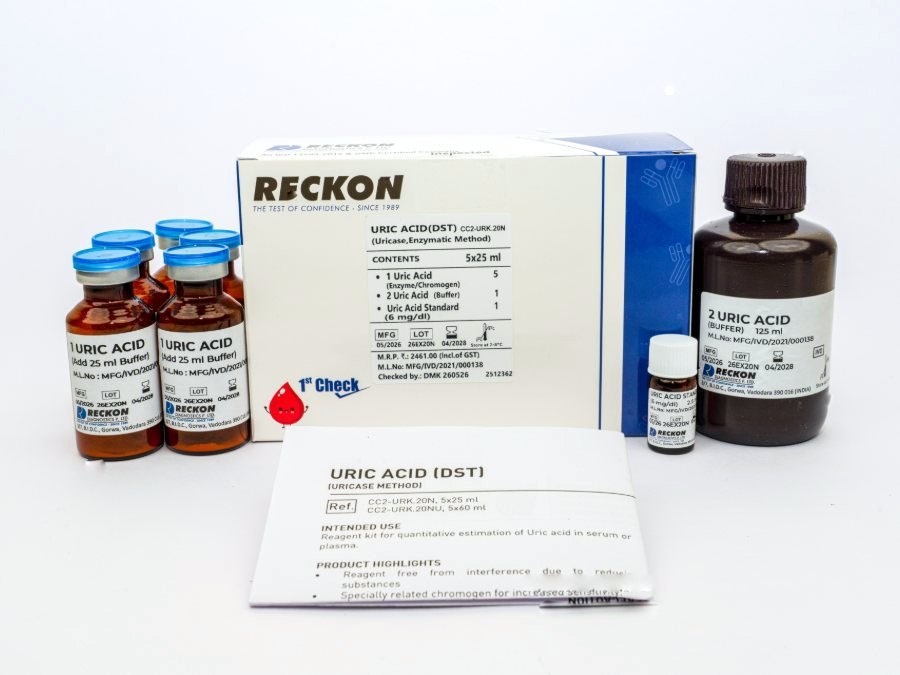
Photographed: the 5 x 25 ml pack, stock code CC2-URK.20N.
DST format. 2 pack sizes, 125 to 300 ml.
Stock code CC2-URK.20N
- Made and batch-released in Vadodara
- ISO 13485:2016 quality system
- Datasheet published: see every stock code below
Product details.
Intended use: Uric Acid (DST) is a reagent kit for the quantitative estimation of uric acid in serum or plasma, by the uricase method after Fossati et al. Uricase converts uric acid to allantoin and hydrogen peroxide, which peroxidase uses with 4-aminoantipyrine and TBHB to form a coloured complex read at 520 nm. Manufactured at Reckon’s Vadodara facility under ISO 13485:2016 quality management, and released against reference standards before dispatch.
The specifications and steps on this page are from the datasheet, last updated 02-2026. The datasheet governs: read it before use, or ask us.
- Method
- Enzymatic uricase-peroxidase
- Sample
- Serum
- Sample volume
- 20 µl (0.02 ml)
- Wavelength
- 520 nm (500 to 550 nm, or a green filter)
- Linearity
- Up to 20 mg/dl
- Storage
- 2 to 8 °C
Full specification20 items
- Category
- Clinical chemistry
- Format
- DST
- Pack
- 125 to 300 ml
- Pack sizes
- 2 to choose from
- Datasheet
- Published
- Method
- Enzymatic uricase-peroxidase, end point
- Sample
- Serum: fresh, clear, fasting, no hemolysis; heparin plasma may be used
- Sample volume
- 20 µl (0.02 ml)
- Reagent volume
- 1.0 ml of working reagent
- Wavelength
- 520 nm (500 to 550 nm, or a green filter)
- Temperature
- 37 °C
- Incubation
- 5 minutes at 37 °C
- Standard
- 6 mg/dl, included
- Reagents
- Enzyme-chromogen powder dissolved in the buffer (25 ml or 60 ml); use after 5 minutes
- Working reagent
- 6 months at 2 to 8 °C; a slight rise in the blank does not affect results
- Colour stability
- 1 hour, protected from direct light
- Caution
- Contains sodium azide; do not ingest
- Storage
- 2 to 8 °C, until the expiry date on the label
- Stock codes
- CC2-URK.20N, CC2-URK.20NU
- Made in
- Vadodara, Gujarat, India
Performance1 figure
- Linearity
- Up to 20 mg/dl; dilute higher samples with 0.9% saline
Procedure at a glance5 steps
- Dissolve 1 vial of uric acid powder in its buffer (25 ml or 60 ml) and wait 5 minutes.
- Pipette 1.0 ml of working reagent into the blank, standard and test tubes; add 0.02 ml of standard and of sample to their tubes.
- Mix and incubate at 37 °C for 5 minutes.
- Read the test and the standard against the reagent blank at 520 nm.
- Uric acid (mg/dl) = absorbance of test ÷ absorbance of standard × 6; multiply by 59.5 for µmol/L.
Every stock code.
Uric Acid (DST) ships in 2 pack sizes, each with its own stock code.
| Stock code | Pack | Photograph | Datasheet |
|---|---|---|---|
| CC2-URK.20N | 5 x 25 ml |  |
Datasheet PDF, CC2-URK.20N |
| CC2-URK.20NU | 5 x 60 ml |  |
Datasheet PDF, CC2-URK.20NU |
Questions and answers.
Uric Acid (DST): what sample does it need?
The datasheet gives the sample as Serum: fresh, clear, fasting, no hemolysis; heparin plasma may be used. The sample volume is 20 µl (0.02 ml).
Uric Acid (DST): what method does it use?
The method on the datasheet is Enzymatic uricase-peroxidase, end point.
Uric Acid (DST): what wavelength is it read at?
According to the datasheet, it is read at 520 nm (500 to 550 nm, or a green filter).
Uric Acid (DST): what is the linear range?
The datasheet gives the linear range as Up to 20 mg/dl; dilute higher samples with 0.9% saline.
Uric Acid (DST): how should it be stored?
The datasheet gives storage as 2 to 8 °C, until the expiry date on the label.
Uric Acid (DST): what pack sizes are available?
It comes in 2 pack sizes, each with its own stock code: 5 x 25 ml (CC2-URK.20N), 5 x 60 ml (CC2-URK.20NU).
More clinical chemistry.
All 50 clinical chemistry reagents →

 Reagent bottle
Reagent bottle
 Reagent bottle
 Reagent bottle
 Reagent bottle
 Reagent bottle
 Reagent bottle