


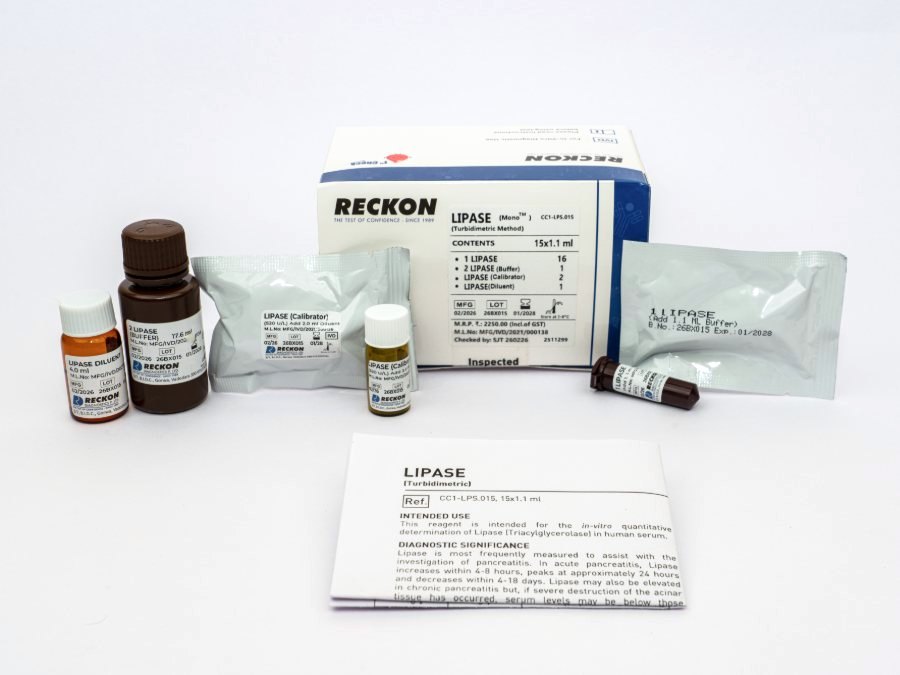
Photographed: the 15 x 1.1 ml pack, stock code CC1-LPS.015.
Supplied as 16.5 ml.
Stock code CC1-LPS.015
- Made and batch-released in Vadodara
- ISO 13485:2016 quality system
- Datasheet published: see every stock code below
Product details.
Intended use: Lipase (turbidimetric) is a reagent for the in vitro quantitative determination of lipase (triacylglycerolase) in human serum, by the method of Ziegenhorn et al. Lipase, with colipase, hydrolyses triolein to glycerides and fatty acids, and the rate of decrease in turbidity at 340 nm is proportional to lipase activity. Manufactured at Reckon’s Vadodara facility under ISO 13485:2016 quality management, and released against reference standards before dispatch.
The specifications and steps on this page are from the datasheet, last updated 02-2026. The datasheet governs: read it before use, or ask us.
- Method
- Turbidimetric
- Sample
- Non-hemolysed serum
- Wavelength
- 340 nm
- Linearity
- Up to 700 U/L
- Storage
- 2 to 8 °C
- Pack
- 16.5 ml
Full specification18 items
- Category
- Clinical chemistry
- Pack
- 16.5 ml
- Datasheet
- Published
- Method
- Turbidimetric, fixed time (decreasing)
- Sample
- Non-hemolysed serum; stable 1 week at 18 to 25 °C, 3 weeks at 2 to 8 °C
- Sample volume
- 0.04 ml, or 0.02 ml in the half-volume procedure
- Reagent volume
- 1.0 ml of working reagent, or 0.5 ml
- Wavelength
- 340 nm
- Temperature
- 37 °C
- Readings
- At 240 seconds and 540 seconds
- Calibration
- Lipase calibrator included; reconstitute with 2.0 ml of diluent
- Working reagent
- 14 days at 2 to 8 °C
- Calibrator stability
- 7 days at 2 to 8 °C; 4 weeks at −20 °C
- Note
- Avoid cross-contamination from cholesterol, triglyceride, HDL and LDL reagents
- Caution
- Avoid ingestion and contact with skin, mouth and eyes
- Storage
- 2 to 8 °C, until the expiry date on the label
- Stock codes
- CC1-LPS.015
- Made in
- Vadodara, Gujarat, India
Performance2 figures
- Linearity
- Up to 700 U/L
- Interference
- None from hemoglobin up to 124 µmol/L, bilirubin up to 342 µmol/L
Procedure at a glance5 steps
- Dissolve 1 vial of 1 Lipase with 1.1 ml of buffer; reconstitute the calibrator with 2.0 ml of diluent.
- Pipette 1.0 ml of working reagent into the calibrator and test tubes; add 0.04 ml of calibrator and of sample to their tubes.
- Mix and read the absorbance at 340 nm at exactly 240 seconds and again at 540 seconds.
- Work out ΔA = A1 − A2.
- Lipase (U/L) = ΔA of sample ÷ ΔA of calibrator × calibrator value.
Every stock code.
Lipase ships in one pack size.
| Stock code | Pack | Photograph | Datasheet |
|---|---|---|---|
| CC1-LPS.015 | 15 x 1.1 ml |  |
Datasheet PDF, CC1-LPS.015 |
Questions and answers.
Lipase: what sample does it need?
The datasheet gives the sample as Non-hemolysed serum; stable 1 week at 18 to 25 °C, 3 weeks at 2 to 8 °C. The sample volume is 0.04 ml, or 0.02 ml in the half-volume procedure.
Lipase: what method does it use?
The method on the datasheet is Turbidimetric, fixed time (decreasing).
Lipase: what wavelength is it read at?
According to the datasheet, it is read at 340 nm.
Lipase: what is the linear range?
The datasheet gives the linear range as Up to 700 U/L.
Lipase: how should it be stored?
The datasheet gives storage as 2 to 8 °C, until the expiry date on the label.
Lipase: what pack sizes are available?
It comes in one pack size: 15 x 1.1 ml (CC1-LPS.015).
More clinical chemistry.
All 50 clinical chemistry reagents →

 Reagent bottle
 Reagent bottle
 Reagent bottle
 Reagent bottle
 Reagent bottle
 Reagent bottle
 Reagent bottle
 Reagent bottle