


Photographed: the 5 x 100 ml pack, stock code CC2-GLU.011.
2 pack sizes, 500 to 1000 ml.
Stock code CC2-GLU.011
- Made and batch-released in Vadodara
- ISO 13485:2016 quality system
- Datasheet published: see every stock code below
Product details.
Intended use: Glucose (5 Min.) is a reagent kit for the quantitative estimation of glucose in serum or plasma, by the GOD/POD method of Trinder with a 5-minute end point. Glucose oxidase produces hydrogen peroxide, which with peroxidase, 4-aminoantipyrine and phenol forms a red quinoneimine dye read at 505 nm in proportion to glucose. Manufactured at Reckon’s Vadodara facility under ISO 13485:2016 quality management, and released against reference standards before dispatch.
The specifications and steps on this page are from the datasheet, last updated 04-2023. The datasheet governs: read it before use, or ask us.
- Method
- Enzymatic GOD/POD (Trinder)
- Sample
- Serum or plasma
- Sample volume
- 10 µl (0.01 ml)
- Wavelength
- 505 nm (500 to 540 nm, or a green filter)
- Linearity
- Up to 500 mg/dl
- Storage
- Enzyme and standard at 2 to 8 °C
Full specification19 items
- Category
- Clinical chemistry
- Pack
- 500 to 1000 ml
- Pack sizes
- 2 to choose from
- Datasheet
- Published
- Method
- Enzymatic GOD/POD (Trinder), end point
- Sample
- Serum or plasma; fluoride, oxalate, EDTA, heparin or none; separate promptly
- Sample volume
- 10 µl (0.01 ml)
- Reagent volume
- 1.0 ml of working reagent
- Wavelength
- 505 nm (500 to 540 nm, or a green filter)
- Temperature
- 37 °C
- Incubation
- 5 minutes at 37 °C; or kinetic, readings at 30 and 90 seconds
- Standard
- 100 mg/dl, included
- Reagents
- Enzyme-chromogen powder dissolved in the glucose phenol reagent
- Working reagent
- 90 days at 2 to 8 °C, protected from light
- Colour stability
- 2 hours at room temperature, protected from light
- Caution
- Contains sodium azide; do not ingest
- Storage
- Enzyme and standard at 2 to 8 °C; phenol reagent at room temperature
- Stock codes
- CC2-GLU.011, CC2-GLU.11U
- Made in
- Vadodara, Gujarat, India
Performance2 figures
- Linearity
- Up to 500 mg/dl; dilute higher samples with 0.9% saline
- Interference
- None from hemoglobin up to 187.5 mg/dl, free bilirubin up to 25 mg/dl, lipemia (as triglycerides) up to 1000 mg/dl
Procedure at a glance5 steps
- Dissolve the enzyme-chromogen powder in the glucose phenol reagent (100 ml, 250 ml or 500 ml).
- Pipette 1.0 ml of working reagent into the blank, standard and test tubes; add 0.01 ml of standard and of sample to their tubes.
- Mix and incubate for 5 minutes at 37 °C.
- Read the standard and the test against the reagent blank at 505 nm.
- Glucose (mg/dl) = absorbance of test ÷ absorbance of standard × 100; divide by 18 for mmol/L.
Every stock code.
Glucose (5 Min.) ships in 2 pack sizes, each with its own stock code.
| Stock code | Pack | Photograph | Datasheet |
|---|---|---|---|
| CC2-GLU.011 | 5 x 100 ml |  |
Datasheet PDF, CC2-GLU.011 |
| CC2-GLU.11U | 4 x 250 ml | 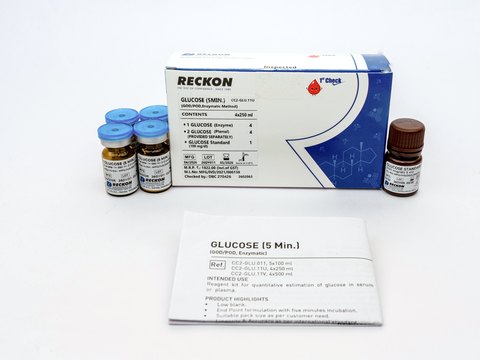 |
Datasheet PDF, CC2-GLU.11U |
Questions and answers.
Glucose (5 Min.): what sample does it need?
The datasheet gives the sample as Serum or plasma; fluoride, oxalate, EDTA, heparin or none; separate promptly. The sample volume is 10 µl (0.01 ml).
Glucose (5 Min.): what method does it use?
The method on the datasheet is Enzymatic GOD/POD (Trinder), end point.
Glucose (5 Min.): what wavelength is it read at?
According to the datasheet, it is read at 505 nm (500 to 540 nm, or a green filter).
Glucose (5 Min.): what is the linear range?
The datasheet gives the linear range as Up to 500 mg/dl; dilute higher samples with 0.9% saline.
Glucose (5 Min.): how should it be stored?
The datasheet gives storage as Enzyme and standard at 2 to 8 °C; phenol reagent at room temperature.
Glucose (5 Min.): what pack sizes are available?
It comes in 2 pack sizes, each with its own stock code: 5 x 100 ml (CC2-GLU.011), 4 x 250 ml (CC2-GLU.11U).
More clinical chemistry.
All 50 clinical chemistry reagents →

 Reagent bottle
 Reagent bottle
 Reagent bottle
 Reagent bottle
Reagent bottle
 Reagent bottle
 Reagent bottle